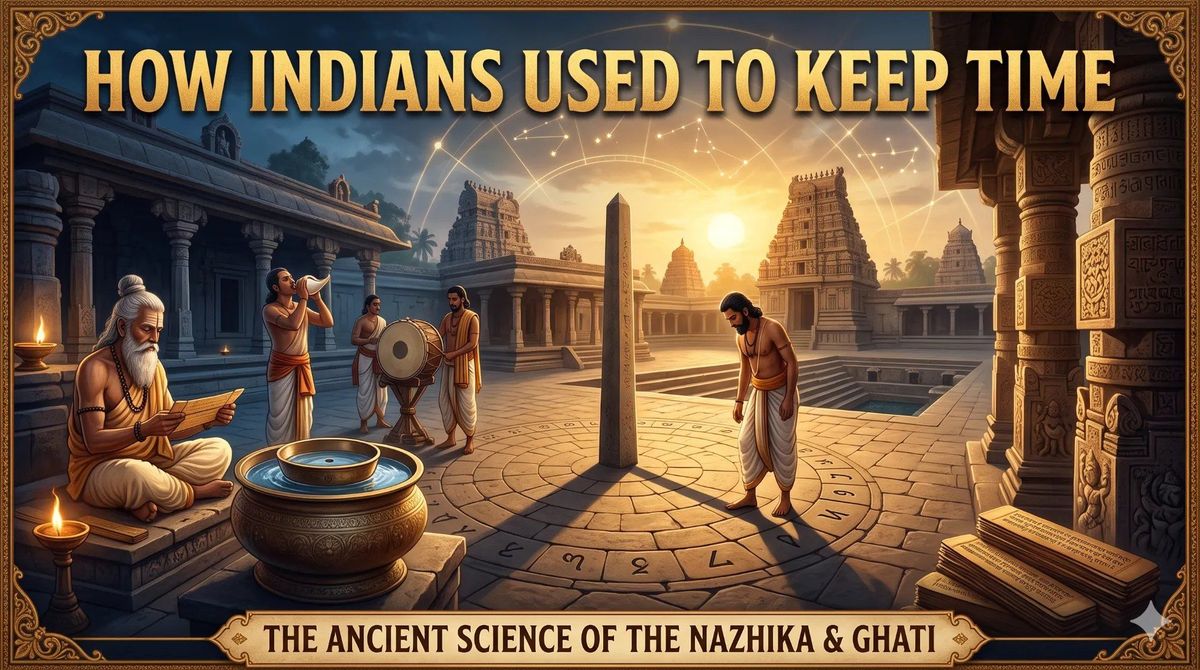
How Indians Used to Keep Time | Part One: Muhurtas, Water Clocks and Shadows
Before clocks with hands, a day in India was divided into 60 parts. In Tamil and Malayalam, that part is called the nazhika (நாழிகை, നാഴിക). In Sanskrit, it is the ghati or ghatika, in Kannada, the ghalige, in Telugu, the ghadiya. One nazhika is 24 minutes. Many panchangas still give the end of a tithi or a nakshatra as a number of nazhikas after sunrise, and Orbit's Panchanga page now shows them that way too.
This is the first of three posts. Here, we’ll see how time was kept. Part Two is the arithmetic of the nazhika, and Part Three will be about inscriptions where it was actually used.
Muhurtas came first
The oldest division of the day I could find is the muhurta. One day was divided into 30 muhurtas. Ebenezer Burgess, who translated the Surya Siddhanta in 1860, calls the thirty-part day "unquestionably the ancient and original Hindu method of reckoning time". The Vedanga Jyotisha, the oldest Indian astronomy text we have (date disputed), has the daytime growing from 12 muhurtas at the winter solstice to 18 at the summer solstice.
A muhurta is 48 minutes, and two nazhikas make one muhurta. So, the two systems sit on top of each other without any trouble.
Water clocks
Two kinds of water clock are described in the texts.
The Arthashastra (book 2, chapter 20) uses one that empties. It defines a nalika as the time taken for one adhaka of water to flow out of a pot through a hole as wide as a gold wire 4 angulas long, made from 4 mashas of gold. Two nalikas make a muhurta. It also says that the day and the night are 15 muhurtas each in the months of Chaitra and Ashvayuja, and that over the next six months one of them grows by 3 muhurtas while the other shrinks by 3.
The Surya Siddhanta (13.23) uses one that fills and sinks:
A copper vessel, with a hole in the bottom, set in a basin of pure water, sinks sixty times in a day and night.
A verse quoted in the commentary gives the size of the bowl: 10 palas of copper, 6 angulas high, twice that wide at the mouth, holding 60 palas of water, with a hole that just lets in a gold pin 4 angulas long weighing 3⅓ mashas. Burgess points out that ghati or ghatika literally means "vessel". The unit is named after the bowl.
He also makes a practical point. A bowl like this cannot be made accurate from measurements alone. It would have had to be checked against some known standard, or by use, and adjusted until it sank 60 times in a day.
Shadows
In the daytime a shadow also tells the time. The Arthashastra gives a table of shadow lengths against fractions of the day, ending with "when no shadow is cast, it is to be considered midday". The third chapter of the Surya Siddhanta works out the time of day from the shadow of a gnomon, and its chapter on instruments mentions the gnomon right after the water bowl.
In Kerala, temple records often give the time by a man's shadow, measured in his own feet. Pandiradi, "twelve feet", is the hour when your shadow is twelve of your own feet long. This comes up again in Part Three, because it matters for what the inscriptions show.
Shadows do not work at night. There the water clock was the answer. Timing a star as it crosses the meridian is another way to keep time. See this blog post that I wrote about the 19th-century transit telescope at the Trivandrum observatory.
Drums, conches and timekeepers
Al-Biruni was in India around 1030. He wrote that in some parts of the country there were water clocks "regulated according to the ghati", used to mark the eight watches of the day and night. One watch is 7½ ghatis, which is 3 hours. At the end of each watch, a drum was beaten and a conch blown. He saw this in the town of Purshur (Peshawar), and he says that pious people had left legacies and fixed incomes to keep these clocks running.
The Tamil poem Mullaippattu, from the Sangam collection, has timekeepers telling a king in his war camp how far the kannal, the water clock, has run. The medieval commentator Naccinarkkiniyar explains it as the nazhigai bowl floating in a vessel of water.
Much later, in the 1590s, Abul Fazl's Ain-i-Akbari describes the ghari bowl and the gong at Akbar's court. He also repeats the Indian rule of 360 breaths to a ghari and 21,600 breaths in a day and night.
Stay tuned for Part Two, where you’ll see where that number comes from.
-Anish
Sources
- E. Burgess (with W. D. Whitney), Translation of the Surya-Siddhanta, Journal of the American Oriental Society 6 (1860): 1.11-12 and note; 13.23-24 and notes.
- R. Shamasastry (trans.), Kautilya's Arthasastra (1915), book 2 chapter 20, p. 119.
- R. Shama Sastry, Vedanga Jyotisha (1936).
- E. C. Sachau (trans.), Alberuni's India (1888), vol. I, pp. 337-338.
- Mullaippattu with Naccinarkkiniyar's commentary, Project Madurai etext pmuni0488.
- Abul Fazl, Ain-i-Akbari, trans. H. S. Jarrett, vol. 3.
Comments
No comments yet. Be the first!