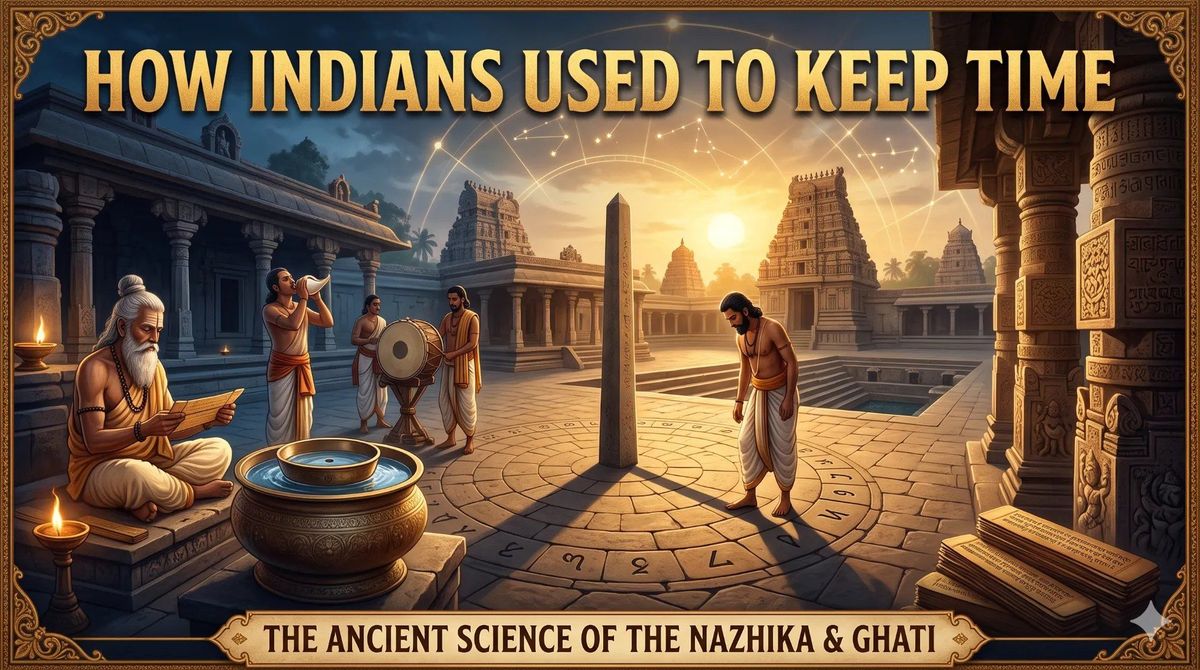
How Indians Used to Keep Time | Part Two: The Nazhika, 24 Minutes and 6 Degrees
This is the second (of three) posts on how Indians kept time. Part One was about the methods: muhurtas, water clocks, shadows and the people paid to keep the clocks. This one is the arithmetic of the nazhika, the sixtieth part of a day. Part Three will be about inscriptions that used it.
Three ways of cutting up a day
The texts agree on the big units and disagree on the small ones. Here are three lists, each as the text gives it.
The Surya Siddhanta (1.11-12):
- the time taken to say 10 long syllables = 1 prana (a breath), also called asu
- 6 pranas = 1 vinadi
- 60 vinadis = 1 nadi
- 60 nadis = 1 day and night
The Arthashastra (book 2, chapter 20):
- 2 trutis = 1 lava, 2 lavas = 1 nimesha, 5 nimeshas = 1 kashtha
- 30 kashthas = 1 kala
- 40 kalas = 1 nalika
- 2 nalikas = 1 muhurta
- 15 muhurtas = 1 day, or 1 night, at the equinox
The Puranic list, as Ebenezer Burgess gives it in his notes to the Surya Siddhanta:
- 15 nimeshas (twinklings) = 1 kashtha
- 30 kashthas = 1 kala
- 30 kalas = 1 muhurta
- 30 muhurtas = 1 day
Burgess adds that Manu makes the kashtha 18 twinklings instead of 15. Nadi, nalika, nazhika and ghati are names for the same 24-minute unit. The vinadi is the vinazhika, and its usual later name is pala.
Turned into modern seconds (my arithmetic, taking a day as 24 hours):
- truti: Arthashastra 0.06 s
- long syllable: Surya Siddhanta 0.4 s
- nimesha: Arthashastra 0.24 s; Puranic list about 0.21 s
- kashtha: Arthashastra 1.2 s; Puranic list 3.2 s
- prana: Surya Siddhanta 4 s
- vinadi (pala): Surya Siddhanta 24 s
- kala: Arthashastra 36 s; Puranic list 96 s
- nadi / nalika: Surya Siddhanta 24 min; Arthashastra 24 min; Puranic list (24 min)
- muhurta: Surya Siddhanta (48 min); Arthashastra 48 min; Puranic list 48 min
All three agree on the 24-minute nadi and the 48-minute muhurta. Below that is where they part ways. The kala is 36 seconds in the Arthashastra and 96 seconds in the Puranic list. Burgess calls the very small units "imaginary subdivisions", and says the Surya Siddhanta, "with commendable moderation", stops at the breath.
Al-Biruni reports the same fit at the top end: two ghatis to a muhurta, and a watch of 3¾ muhurtas, which is 7½ ghatis or 3 hours. The Ain-i-Akbari's 360 breaths to a ghari is the Surya Siddhanta's 6 pranas times 60 vinadis.
The nazhika and the circle
Set the Surya Siddhanta's units next to the divisions of a circle:
- 1 day: Part of a day 1; Clock time 24 hours; Turn of the sky 360 degrees
- 1 nazhika (nadi, ghati): Part of a day 1/60; Clock time 24 minutes; Turn of the sky 6 degrees
- 1 vinazhika (vinadi, pala): Part of a day 1/3,600; Clock time 24 seconds; Turn of the sky 6 arc minutes
- 1 prana (asu): Part of a day 1/21,600; Clock time 4 seconds; Turn of the sky 1 arc minute
The clock time column is plain division. A day is 24 × 60 = 1,440 minutes, and 1,440 / 60 = 24 minutes. A sixtieth of 24 minutes is 24 seconds. A sixth of 24 seconds is 4 seconds.
The sky column is the same division applied to a circle. The sky turns once, 360 degrees, in a day. 360 / 60 = 6 degrees per nazhika. A degree has 60 arc minutes, so 6 degrees is 360 arc minutes, and a sixtieth of that is 6 arc minutes per vinazhika. A sixth of 6 arc minutes is 1 arc minute per prana. So, there are 21,600 pranas in a day, and 21,600 arc minutes in a circle.
Burgess noticed this in 1860. He says the respiration "is the same part of the day as the minute is of the circle". An astronomer could go from a time to an angle with no conversion at all. If one star crosses the meridian 90 pranas after another, they are 90 arc minutes apart in right ascension.
A few more that follow from the same table:
- 1 degree of turn is 60 pranas, which is 10 vinazhikas, or 4 minutes.
- 1 hour is 15 degrees, which is 2½ nazhikas.
- Going one step below the prana, which the Surya Siddhanta does not do: 1 second of clock time is 15 arc seconds of turn, and 1 arc second is a fifteenth of a second.
Which day: the stars or the Sun
The sky does not turn 360 degrees in 24 hours. It turns once in a sidereal day of 23 hours 56 minutes 4.09 seconds, which is 86,164.09 seconds. The Surya Siddhanta says its 60 nadis make a sidereal day, so for the astronomer the match with the circle is exact.
Divide the sidereal day by 60 and a nadi comes out at 1,436.07 seconds, or 23 minutes 56.07 seconds. The everyday nazhika, a sixtieth of the day from sunrise to sunrise, is 24 minutes, 1,440 seconds on average. The difference is 3.93 seconds per nazhika, and 3 minutes 56 seconds over a whole day. The sidereal vinadi is 23.93 seconds and the sidereal prana 3.99 seconds.
This is the same difference that makes a star cross the meridian about 3 minutes 56 seconds earlier each night. Over a month it adds up to about 2 hours.
Converting both ways
Here, some round numbers worth keeping in your head:
- Nazhikas: 1 = 24 minutes; Vinazhikas: 1 = 24 seconds
- Nazhikas: 2½ = 1 hour; Vinazhikas: 2½ = 1 minute
- Nazhikas: 5 = 2 hours; Vinazhikas: 5 = 2 minutes
- Nazhikas: 7½ = 3 hours (one watch); Vinazhikas: 10 = 4 minutes
- Nazhikas: 10 = 4 hours; Vinazhikas: 15 = 6 minutes
- Nazhikas: 15 = 6 hours; Vinazhikas: 30 = 12 minutes
- Nazhikas: 30 = 12 hours; Vinazhikas: 60 = 24 minutes (1 nazhika)
The short version: hours × 2½ = nazhikas, and nazhikas × 0.4 = hours. The same factors work one level down, between minutes and vinazhikas.
From the clock to nazhikas
Take the minutes since sunrise and divide by 24. Say sunrise was at 6:12 and it is now 10:40. That is 4 hours 28 minutes, or 268 minutes. 268 / 24 = 11, with 4 minutes left over. 4 minutes is 240 seconds, and 240 / 24 = 10 vinazhikas. So 10:40 is sunrise + 11 nazhika 10 vinazhika. This is the form Orbit uses on the Panchanga and Date Verifier pages.
From nazhikas to the clock
Say a panchanga gives the end of a tithi as sunrise + 23 nazhika 15 vinazhika, and sunrise was at 6:14.
That is:
23 × 24 = 552 minutes, which is 9 hours 12 minutes. 15 × 24 = 360 seconds, which is 6 minutes. Together that is 9 hours 18 minutes after 6:14, so the tithi ends at 15:32.
The count starts at the local sunrise. The same "sunrise + 23 nazhika" is a different clock time in Bangalore and in Ujjain on the same day, because the Sun rises at a different time in each place.
How many nazhikas of daylight
Day and night together are always 60 nazhikas, but the daylight share changes through the year.
The Vedanga Jyotisha has a rule for it.
In Shama Sastry's translation (verse 8 in his numbering), the day grows by "one Prastha of water" each day while the Sun goes north, and shrinks by the same while it goes south. The total change over one half-year is six muhurtas. His commentary takes 183 prasthas as 12 nadikas. So the day grows by 12 / 183 = 4/61 of a nazhika every day, about 1 minute 34 seconds, from 12 muhurtas (24 nazhikas) at the winter solstice to 18 muhurtas (36 nazhikas) at the summer solstice. Verse 24 defines the nadika itself as a measure of water: a drona less three kudavas.
Here is that rule against the real length of the day (my arithmetic, using the Sun's upper edge, the usual allowance for refraction, and today's tilt of the Earth's axis):
- Days after the winter solstice 0: Vedanga Jyotisha rule 24.0; Ujjain (23.2° N) 26.8; Bangalore (13.0° N) 28.4
- Days after the winter solstice 30: Vedanga Jyotisha rule 26.0; Ujjain (23.2° N) 27.3; Bangalore (13.0° N) 28.7
- Days after the winter solstice 61: Vedanga Jyotisha rule 28.0; Ujjain (23.2° N) 28.7; Bangalore (13.0° N) 29.4
- Days after the winter solstice 91: Vedanga Jyotisha rule 30.0; Ujjain (23.2° N) 30.3; Bangalore (13.0° N) 30.3
- Days after the winter solstice 122: Vedanga Jyotisha rule 32.0; Ujjain (23.2° N) 32.0; Bangalore (13.0° N) 31.2
- Days after the winter solstice 152: Vedanga Jyotisha rule 34.0; Ujjain (23.2° N) 33.3; Bangalore (13.0° N) 31.9
- Days after the winter solstice 183: Vedanga Jyotisha rule 36.0; Ujjain (23.2° N) 33.9; Bangalore (13.0° N) 32.2
Daylight in nazhikas. 30 nazhikas is 12 hours.
First, the real day does not change at a steady rate. Near the solstices it hardly changes at all, under a second a day at Ujjain. Near the equinoxes it changes fastest, about 81 seconds a day at Ujjain and 43 seconds a day at Bangalore. The Vedanga Jyotisha adds the same 94 seconds every day. A straight line between the two known ends is the simplest rule there is.
Second, the size of the swing. The rule moves 12 nazhikas over the half-year. Ujjain moves about 7, and Bangalore under 4. A longest-to-shortest ratio of 3 to 2 fits the far north-west of the subcontinent, around 35° N. Shama Sastry himself says a difference this large occurs only near Kashmir. (The Earth's axis was tilted slightly more three thousand years ago, which widens the swing a little, but not by anything this large.)
Pala: a weight and a time
One word does two jobs. In the Surya Siddhanta's water clock, the bowl is "10 palas" of copper and holds "60 palas" of water. There, pala is a weight. Burgess says the usual name for the vinadi is pala, and there it is the 24-second unit of time. When an old text says pala, be sure to check whether it is weighing copper or counting time.
Don’t miss Part Three, about inscriptions that used the nazhika in practice: temple routines, water turns and clocks given to temples, with land to pay the people who kept them.
-Anish
Sources
- E. Burgess (with W. D. Whitney), Translation of the Surya-Siddhanta, Journal of the American Oriental Society 6 (1860): 1.11-12 and notes (including the Puranic list); 13.23 and note.
- R. Shamasastry (trans.), Kautilya's Arthasastra (1915), book 2 chapter 20, p. 119.
- R. Shama Sastry, Vedanga Jyotisha (1936), verses 8 and 24 with the translator's commentary.
- E. C. Sachau (trans.), Alberuni's India (1888), vol. I, pp. 337-338.
- Abul Fazl, Ain-i-Akbari, trans. H. S. Jarrett, vol. 3.
- Day lengths and conversions: my own arithmetic (Sun's upper limb, standard refraction of 0.833 degrees, obliquity 23.44 degrees, sidereal day 86,164.09 seconds).
Comments
No comments yet. Be the first!