The essential reading list, part two
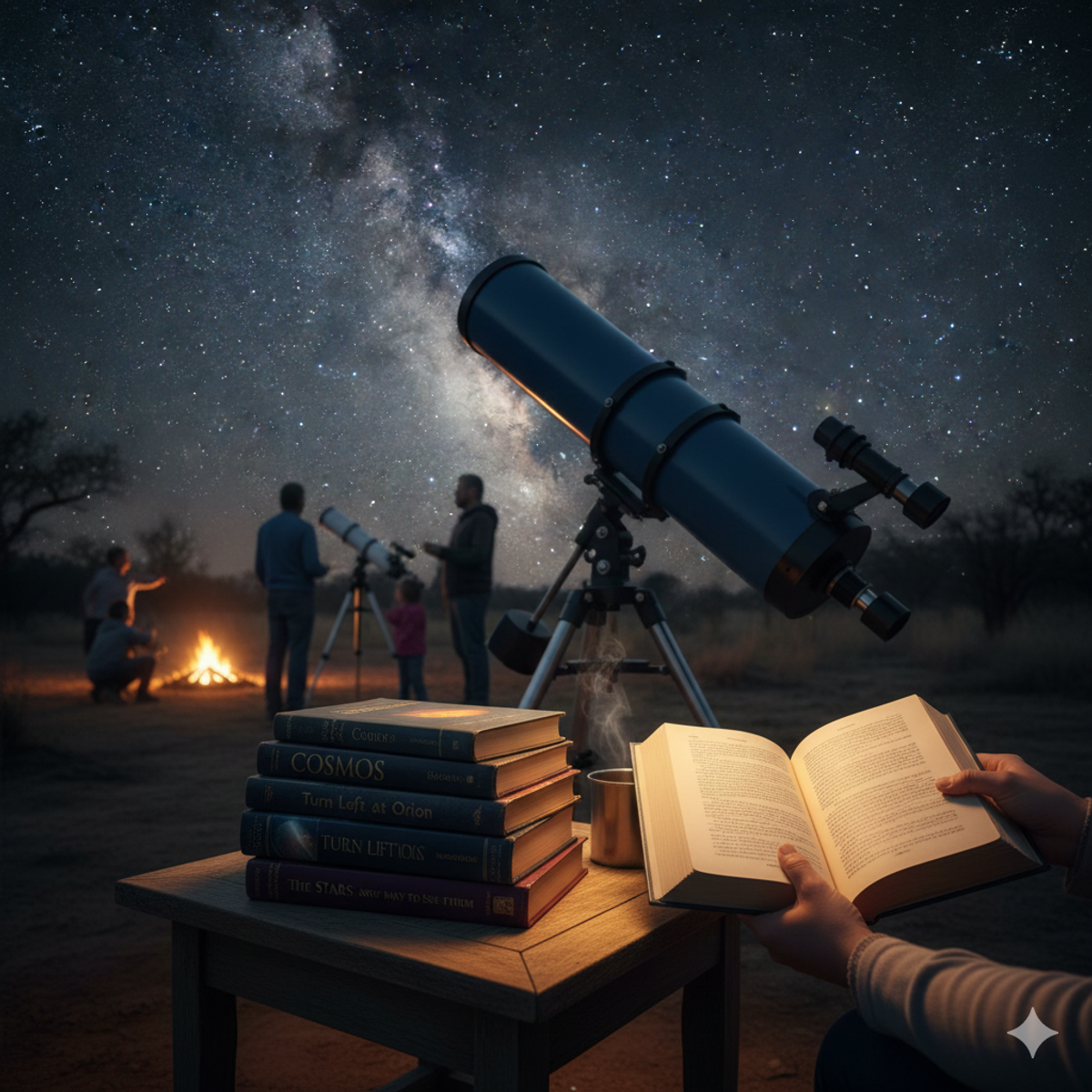
In the first list I said to watch this space for a second one. Here it is. Same idea as before: books that give you context for what you see in the sky. This time each book also comes with one thing you can try on Orbit or EclipseDB, our own sites, so the reading turns into looking up.
1. The absolute beginner
Pale Blue Dot, by Carl Sagan
Sagan's follow-up to Cosmos, named after the photo Voyager 1 took of Earth from about 6 billion kilometres away. It is about where we are in the universe, and where we might go next.
Earth's round shadow is something you can see with your own eyes when it crosses the Moon. Our Eclipses page lists the next lunar eclipses visible from where you live.
Death by Black Hole, by Neil deGrasse Tyson
Forty-odd short essays from Tyson's column in Natural History magazine. Easy to read one at a time, and they cover everything from black holes to how science actually works.
The black hole at the centre of our galaxy lies in Sagittarius, behind the brightest part of the Milky Way. Our Milky Way Finder shows the best windows to see that part of the sky from your location.
Brief Answers to the Big Questions, by Stephen Hawking
Hawking's last book, published after his death in 2018. Ten big questions, from how it all began to whether time travel is possible.
We can't take you back in time, but our Date Verifier shows the sky over any place, on any date from 13,000 BCE to 17,000 CE.
A Short History of Nearly Everything, by Bill Bryson
Bryson is not a scientist, and that is the point. He asks how we know what we know, from the Big Bang to the first living cells, and tells it with a lot of humour.
If it leaves you wanting to start on the sky itself, our free 21 Day Astronomy Course is a gentle way in.
2. The practical enthusiast
The Backyard Astronomer's Guide, by Terence Dickinson and Alan Dyer
From the author of NightWatch in the first list. This is the one to read before you buy binoculars or a telescope, and to keep near the scope afterwards.
If you already have a scope, did you know that Orbit's Tonight page lists the galaxies, nebulae and clusters above your horizon right now, filtered by your equipment, from binoculars to an 8-inch telescope?
Collins Gem Stars, by Ian Ridpath and Wil Tirion
A pocket-size star guide with charts for every constellation, by one of the best known star-chart makers. Small enough to carry to every camp.
Keep it with our Sky Chart on your phone: a planisphere in your browser that shows the constellations above you, for your time and place.
Seeing in the Dark, by Timothy Ferris
About amateur astronomers around the world and what they have discovered, with a practical observing guide at the end.
How dark is your sky? Our Light Pollution Guide explains the Bortle scale and what you can expect to see from where you live.
3. The deep diver
A Brief Welcome to the Universe, by Neil deGrasse Tyson, Michael A. Strauss and J. Richard Gott
A pocket-size version of the book that grew out of their Princeton course for non-science students. Stars, planets, galaxies and the universe as a whole, at a step up from the beginner books.
To put the chapters to use, our Events page lists the eclipses, conjunctions and oppositions coming up in the sky.
Black Holes and Time Warps, by Kip S. Thorne
The history of Einstein's relativity and the search for black holes, told by the physicist who later shared the Nobel Prize for detecting gravitational waves.
Einstein's bending of starlight was first tested at the total solar eclipse of 29 May 1919. You can look it up in the Eclipse Explorer at eclipsedb.org.
4. Indian astronomy
Surya Siddhanta, translated by Ebenezer Burgess
The 1860 English translation of the best-known Indian astronomy text, with Burgess's notes. It is the translation quoted in our series How Indians Used to Keep Time.
The Surya Siddhanta counts its days from midnight at Ujjain at the start of the Kali age, 18 February 3102 BCE. See the sky that night in our Date Verifier.
The Aryabhatiya of Aryabhata, translated by Walter Eugene Clark
All 121 verses of Aryabhata's work, in English, with Clark's notes. Aryabhata explains eclipses by the Earth's shadow and the Moon, and gives his age as 23 when 3,600 years of the Kali age had passed, which is 499 CE.
On 5 September 499 CE a total eclipse of the Moon was visible from Pataliputra, close to where Aryabhata worked. See it in our Date Verifier.
A note for young stargazers and parents
Find the Constellations, by H. A. Rey
The children's version of The Stars from the first list, with the same easy constellation shapes.
Once they have found the Big Dipper, our Star Lore page tells them its Indian name, the Saptarishi, and how to find Arundhati.
Professor Astro Cat's Frontiers of Space, by Dominic Walliman and Ben Newman
A big illustrated book, written by a physicist, that takes children from the Earth out to the edge of the universe.
For a real spacecraft, our ISS Pass Predictor tells you when the Space Station will fly over your home.
My First Book of Planets, by Bruce Betts
A simple first book on the planets for younger children.
Then go outside: our Planet Tracker shows which planets are up tonight and which direction to look.
Affiliate disclosure: some links in this article are Amazon affiliate links. If you buy a book after clicking one, we may earn a small commission at no extra cost to you.
If you are leaving a comment, please also leave your name.
Comments
No comments yet. Be the first!